Three Visiting Researchers
Open Lab 119, Fri Mar 06 2026
Where: University of Iceland. Veröld, room VHV-104
When: Friday, March 6th, 3-6 PM
Cagri Erdem: Steering is the New Control: Toward Trajectory-Based Rhythm Sequencing.
I will present RhyGlyph as an application and interface that embodies our perspective of seeing rhythm as motion. Instead of drawing drum patterns as sequences of individual hits, it turns the rhythmic relationship between each pair of instruments (kick–snare, snare–hi-hat, hi-hat–kick) into three trajectories on a radial glyph surface, so you can quickly spot feel, density, symmetry, and push–pull interactions at a glance. More importantly, it is built around a visualization-as-control direction: what you see is meant to be something you can actively shape. Building on that idea, RhyDiff extends the system from visualization to generation. You reshape the trajectories and metadata, such as tempo and meter, and a generative model proposes new drum grooves that reflect those edits. The next step, RhySeq, brings this approach off the screen and into a tangible prototype: a self-contained rhythm sequencer in which one can move physical elements on a radial surface in real time to play with and deform rhythmic trajectories, serving as a performance and composition tool that combines visualization with a generative instrument.
Bio:
Çağrı Erdem (he/him) is a programmer–composer and improvisor. He develops much of his music alongside musical human-computer interaction research. His previous work focused on creating biosignal-based musical interfaces and explored various forms of human-AI collaboration in performance and composition. As a postdoctoral fellow in the Department of Informatics at the University of Oslo, he continues his research in multimodal interaction techniques, exploring the entanglement of relations, trajectories, and networks.
Chris Kiefer: Machine Learning and Mapping Design with the MEMLNaut.
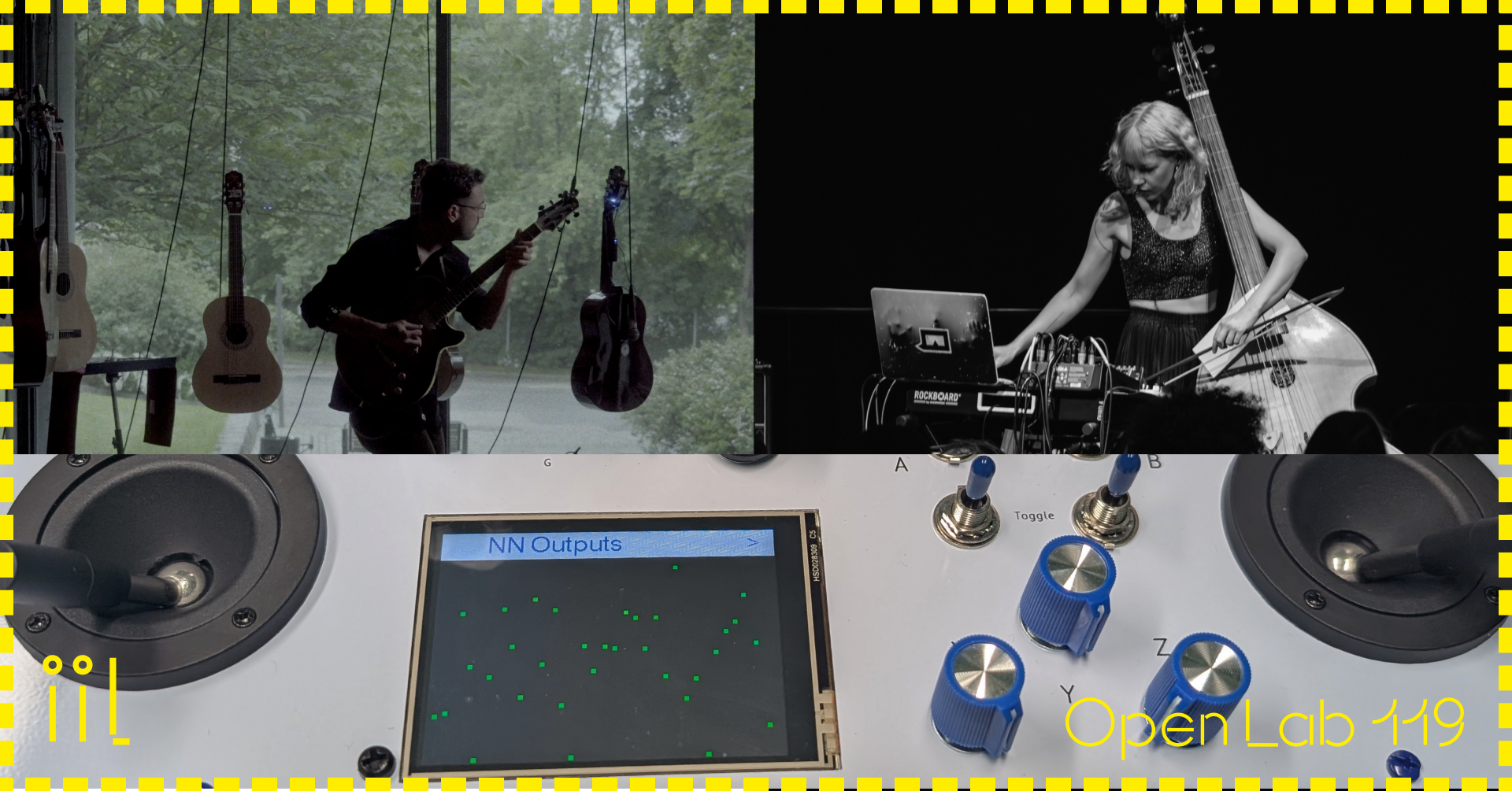
This will be a live demo of the most recent developments of the MEMLNaut machine learning instrument. I will show our new system, NISPS (Neural Interactive Shaping of Parameter Spaces), a reinforcement learning inspired system for performative design of multiparametric mappings.
Bio:
Chris Kiefer is a computer-musician and musical instrument designer from Brighton UK, where we works in the University of Sussex Experimental Music Technologies Lab. He performs and records with custom-made instruments, exploring lively algorithms and feedback processes. As a live coder and solo-feedback musician he performs under the name ‘Luuma’, with a recent release ‘Ffroeds’ on the Flaming Pines label. He plays an augmented self-resonating cello as half of improv-duo Feedback Cell, and with the feedback-drone-quartet ‘Brain Dead Ensemble’.
https://musicallyembodiedml.github.io/
Chloë Sobek: Fracturing Musical Hyperreality: Collage and More-Than-Human Relations in Instrumental Practice.
In this presentation, Chloë Sobek introduces her current practice-based research examining the phenomenon of musical hyperreality; a condition in which cultural forms cease to mediate social, ritual, or political relations and instead circulate as self-referential signs. Within such conditions, musical practices once embedded in relational and situated lifeworlds risk becoming abstracted sign-objects, their value determined less by reciprocity or consequence than by regimes of circulation and exchange. Drawing on Jean Baudrillard alongside the phenomenological and ecological thought of Maurice Merleau-Ponty and David Abram, Sobek situates musical expression within the human body’s entanglement with the more-than-human. Through her instrumental practice with historical and contemporary stringed instruments, she explores the notion of “playing sound” and employs collage as both compositional and performative strategy, foregrounding discontinuity, friction and placing seemingly incongruous materials side by side so that new meanings might emerge from their proximity. The presentation proposes collage and embodied instrumental practice as experimental methods for interrupting the “smoothness” of hyperreality, rendering mediation perceptible and re-sensitising listening to material and ecological entanglement.
Bio:
Chloë Sobek is a composer-performer based in Naarm (Melbourne), Australia. Her practice explores how musical expression emerges from the body’s entanglement with the more-than-human, positioning instrumental performance as both aesthetic and critical inquiry. Working primarily with the Renaissance violone, Sobek treats the instrument as a site of material resistance, historical resonance and experimental transformation.
Her work spans disparate forms, from acoustemology to Noise music, situating these within experimental composition and employing collage as both compositional and performative method through the layering of archival fragments, environmental sound, improvisation and extended string techniques.
Sobek’s practice combines maximalist intensity with an attention to material thresholds, pushing sound and instrument toward points of resistance and breakage; foregrounding friction, rupture and embodied labour. She has been described as “an artist that is thinking deeply about how to aestheticise what’s on everyone’s mind; to use art to drive engagement with ideas whilst pushing the boundaries of technique and technicality.” — Kieran Ruffles, 4ZZZ.
Where: University of Iceland. Veröld, room VHV-104
When: Friday, March 6th, 3-6 PM
We look forward to seeing you!
Free entry.


The Intelligent Instruments project (INTENT) is funded by the European Research Council (ERC) under the European Union’s Horizon 2020 research and innovation programme (Grant agreement No. 101001848).